

up front w/
ROBIN ARSENEAULT
KABLUSIAK
TYLER LOS-JONES
RACHEL MACFARLANE
EXHIBITION
OPENING RECEPTION
The Exhibition


The Work
-
KABLUSIAK

-
ROBIN ARSENEAULT

-
RACHEL MACFARLANE

-
RACHEL MACFARLANE

-
TYLER LOS-JONES

-
TYLER LOS-JONES
-
TYLER LOS-JONES

-
TYLER LOS-JONES

-
TYLER LOS-JONES

The Artists
ROBIN ARSENEAULT
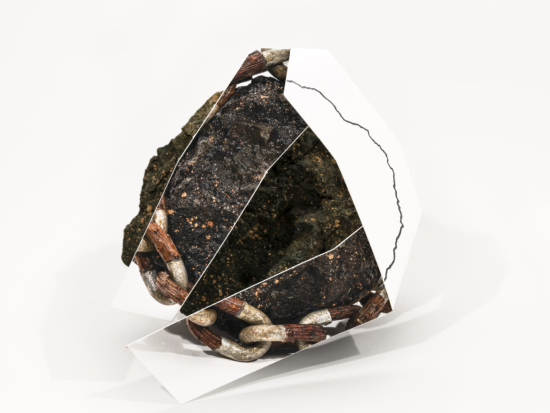
Expulsion is one of a series of five works that resulted from the time Arseneault spent at the Medalta International Artists’ Residency in Medicine Hat. Each work in the series includes a photograph Arseneault took in Southern Alberta of spherical rock formations called concretions, which were paired with images of classical Rodin sculptures. The digitally collaged final image optically shifts from a flat, two-dimensional representation of the scanned, grainy Rodin image (taken from a 1930s educational book) to a three-dimensional sense of volume and space. Rodin’s sculpture pictured here, Constellation, shows the feet of two figures emerging or being expelled from the carved stone. Its base transforms into two bulbous shapes “carved” from our natural environment, eye-like and bodily. Combined, the images elicit a doubling of image, material, and meaning that considers the relationship between sculpture/photography, body/landscape, and acceptance/rejection.
KABLUSIAK
Kablusiak is a multidisciplinary Inuvialuk artist who works across a wide range of materials including soapstone, permanent marker, bed sheets, felt, fur, and text. Their practice explores the dis/connections of existing both within and outside of Inuit Nunangat, the ongoing impacts of colonization on gender and sexuality, the humour embedded within daily life, and the complexities of contemporary Indigenous experience.
“TY Again, Mr. Sobey” continues a body of work first initiated through a drawing made in 2019, when Kablusiak was initially shortlisted for the Sobey Art Award. This later soapstone iteration, depicting a figure on bended knee surrounded by dollar signs, was created during the second year they were shortlisted, the same year they ultimately received the prestigious award. Both humorous and cutting, the work extends Kablusiak’s sharp use of satire, offering a tongue-in-cheek “thank you” to grocery heir Rob Sobey while simultaneously reflecting on system of patronage, power, recognition, and the uneasy relationship between art and capital.
TYLER LOS-JONES
The photographs included in Sediments and Sunlight focus on the material history of the Crowsnest Pass area of South Western Alberta. The exposed strata of the mountains surrounding Crowsnest Pass serve as a reminder of the extraordinary amount of time and energy which has produced our environment. Found within the layers of strata are seams of coal; dense black bands of compressed extinct organisms who thrived over 100 million years ago. These ancient plants spent their lives storing solar energy through photosynthesis. In spite of the vast expanse of time which separates our lives from theirs, the warmth of the energy they collected can be felt when we burn Crowsnest coal today. Crowsnest Pass is not a location where the myth of a static, objective or disconnected landscape has much credence; the area is notable for the relationship it’s inhabitants have to a dynamic environment. We only have to look to Turtle Mountain and the devastation caused by the infamous Frank Slide of 1903 to be reminded of how seemingly static environments are patiently waiting for the moment when they can embrace raucous activity. Markers signifying the many ways people navigate and relate to this shifting environment are scattered throughout Crowsnest Pass; these markers have informed the work included in Sediments and Sunlight.”
RACHEL MACFARLANE
MacFarlane’s works expand on the long-standing genre of landscape painting to account for current ecological pressure on natural spaces. Her works speak to our complicated relationship to the natural world, in light of climate crises and the proliferation of digital, simulated landscapes that act as a form of surrogate landscapes. To begin her studio process, MacFarlane constructs paper maquettes within small, shallow boxes to initiate each painting. These maquettes function almost as scientific experiments, as the artist plays with different light colors and shadows. The paintings then evolve into speculative fiction, illustrating the changing landscape or envisioning its potential future – one taken over by flora, fabricated and rebuilt, and full of unknown phenomena. New ideas for works are often triggered by expeditions to different sites; MacFarlane chooses places purposefully based on their ecologies to get a pulse on various kinds of current environmental changes.
